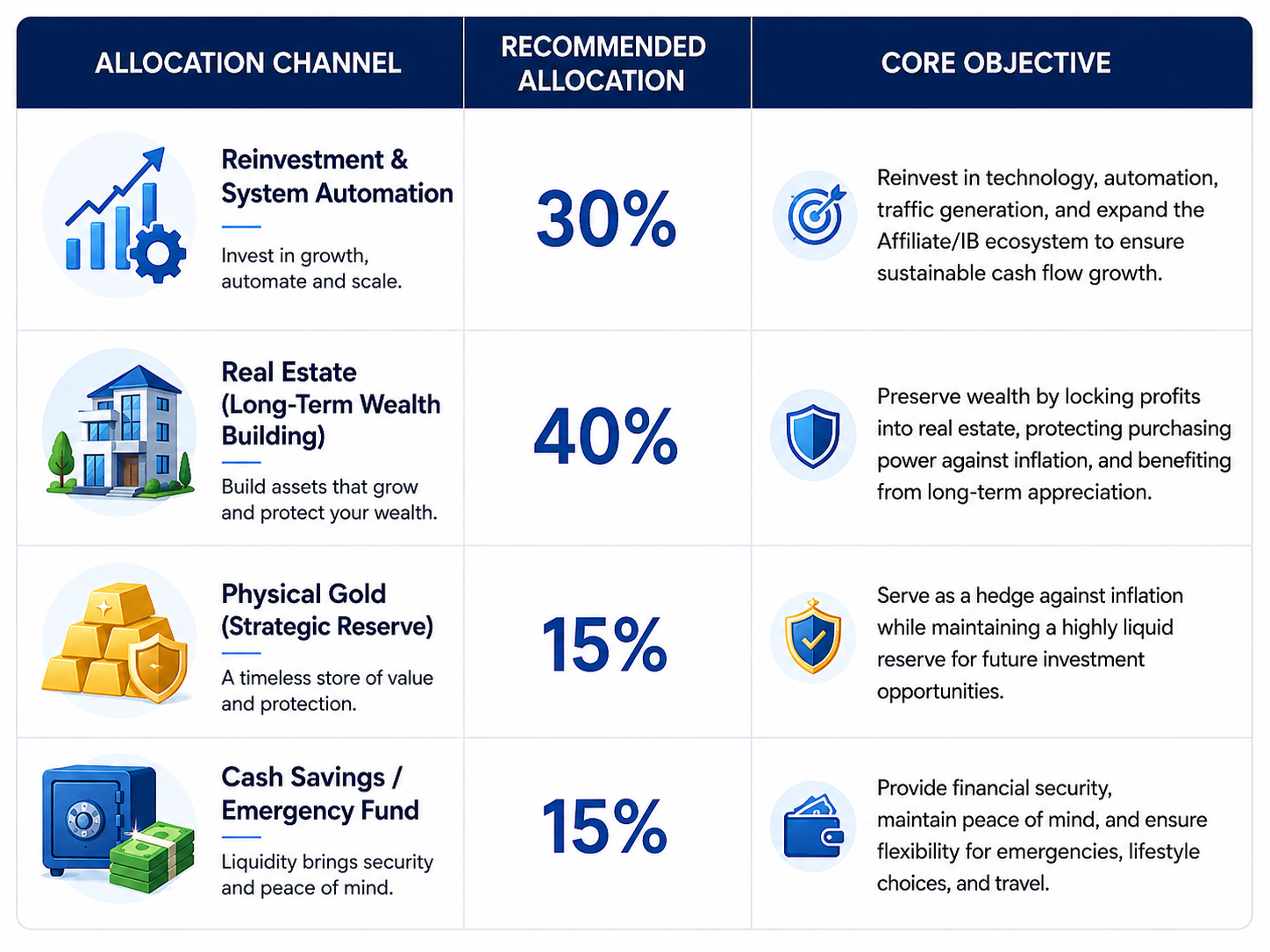


The biggest difference between a sustainable MMO entrepreneur and someone who simply earns more only to spend more—or loses it through high-risk trading—is their approach to capital allocation. Generating income from the financial markets is a valuable skill, but preserving those profits and converting them into safer, real-world assets is the true measure of long-term financial maturity.
This article explores a practical capital allocation framework designed to help you transition affiliate income into a solid financial foundation—one that allows you to enjoy financial freedom today while building lasting asset protection for the future.
1. The Core Principle of Capital Allocation: The “Communicating Vessels” Model
In personal finance, your income sources and investment vehicles can be viewed as connected vessels, each with distinct characteristics.
Affiliate / Trading / MMO Income: This is the high-flow vessel. It is capable of generating substantial cash flow in a short period, offering high return potential. However, it is also highly sensitive to market volatility, broker policy changes, and business risks, making it inherently less predictable.
Gold / Real Estate / Savings: This is the stable asset vessel. Capital accumulates at a slower pace, and expected returns may be more modest, but these assets typically provide greater stability, stronger capital preservation, and lower long-term risk.
The primary objective of sound financial management is to consistently transfer a portion of capital from high-risk, high-cash-flow activities into lower-risk, long-term assets.
The Golden Rule: Never reinvest 100% of your profits back into high-risk activities. Instead, establish an automatic allocation process as soon as affiliate commissions or trading income are received. While you cannot control when financial markets become volatile, you can control how much of your wealth has already been secured in stable assets before that volatility arrives.
2. A Four-Step Strategy for Transitioning Capital from High-Risk Income to Safer Assets
To ensure a smooth capital allocation process without disrupting your operating capital or the performance of your affiliate business, it is advisable to follow a structured progression—from highly liquid reserves to long-term wealth-building assets.
Step 1: Build a Strong Foundation with an Emergency Fund (Bank Savings)
Before considering long-term investments such as real estate or gold, your first priority should be establishing a financial safety net capable of protecting your personal finances from unexpected disruptions. Without an emergency fund, any interruption to your affiliate business or trading income may lead to emotional decision-making or force you to withdraw capital from your business to cover living expenses.
Action Plan: Set aside cash equivalent to 6–12 months of essential living expenses and keep it in a savings account or short-term bank deposit with a reputable financial institution.
Step 2: Build Wealth Consistently with Physical Gold (A Safe-Haven Asset with High Liquidity)
Gold has long been regarded as a safe-haven asset, particularly during periods of inflation, economic uncertainty, or financial instability. For financial affiliates whose income is generated on a weekly or monthly basis, physical gold can serve as an effective long-term wealth preservation vehicle.
Allocation Strategy: Develop the habit of allocating 15%–20% of your monthly net profit to purchasing physical gold. Where appropriate, prioritize highly liquid investment-grade gold products to help minimize transaction costs when buying or selling.
Primary Objective: Gold serves as a capital preservation asset while maintaining excellent liquidity. Even during periods when real estate markets slow down or credit conditions tighten, physical gold can generally be converted into cash quickly. This liquidity provides strategic financial flexibility, allowing you to seize attractive investment opportunities when they arise.