


Financial markets offer attractive profit opportunities, but for beginners, entering this world is much like learning a new language. If you don’t understand the market’s “language,” you are far more likely to make costly decisions that can lead to capital losses.
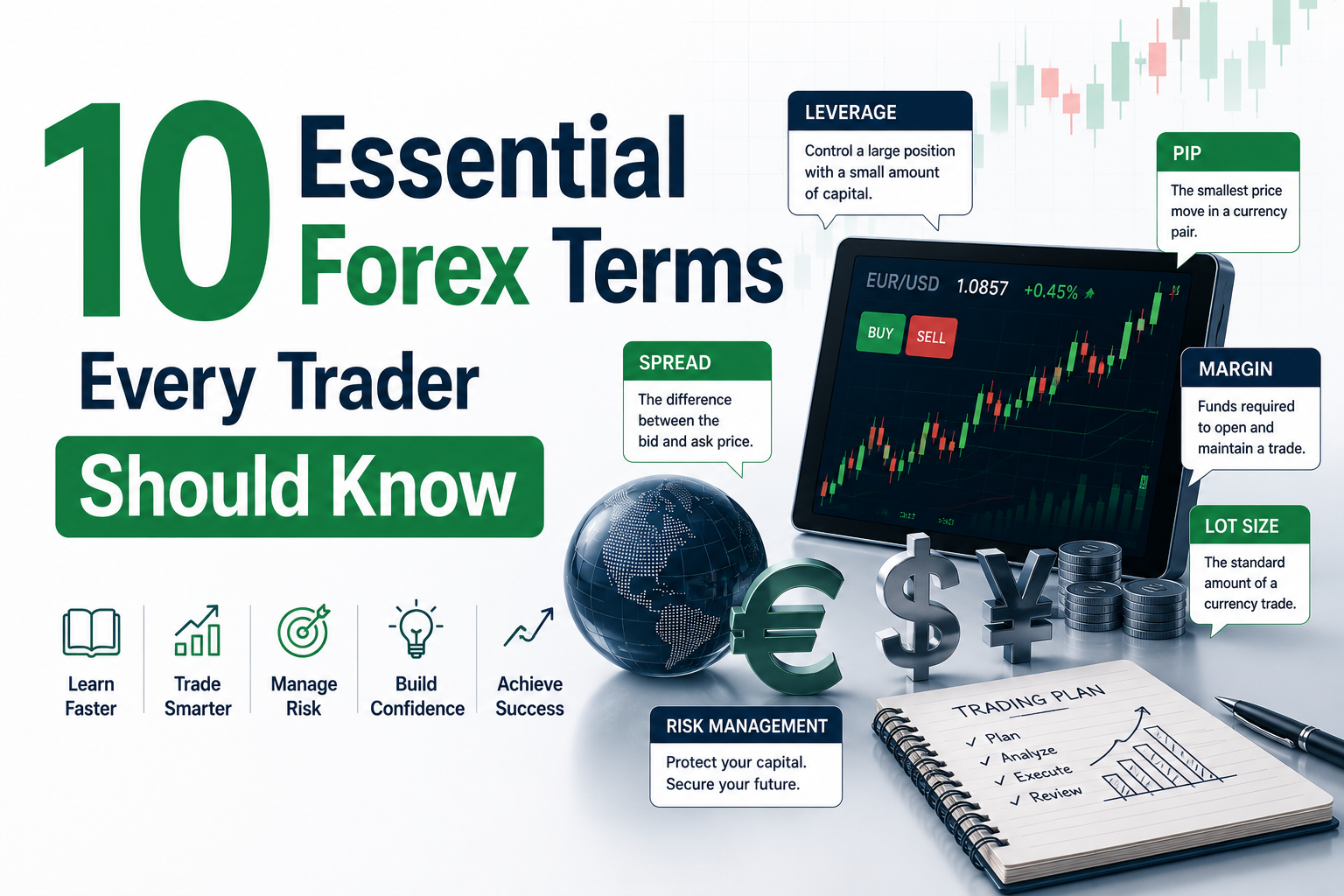
In this article, MMO INCOME summarizes and explains the 10 most essential terms in CFD (Contract for Difference) trading in a clear and easy-to-understand way. Mastering these fundamental concepts is the first step toward becoming a more confident and risk-aware trader.
1. CFD (Contract for Difference)
First, it’s important to understand the market you’re trading in. A CFD (Contract for Difference) is a type of derivative financial instrument. When you trade CFDs—whether on Gold, Forex, Indices, or other markets—you do not actually own the underlying asset. For example, buying a Gold CFD does not mean you physically own gold.
Instead, you are speculating on the price movement of the asset between the time you open and close your position. If the market moves in the direction you predicted, you make a profit. If it moves against your position, you incur a loss.
2. Pip and Lot (Trading Units)
These are two fundamental concepts used together to measure price movement and trading volume.
Pip (Percentage in Point): A pip is the smallest standard unit used to measure the price movement of a currency pair or other trading instrument. (For example, if GBP/USD moves from 1.2500 to 1.2501, it has moved 1 pip.)
Lot: A lot is the standard unit used to measure trade size. One Standard Lot typically represents 100,000 units of the base currency.
Tip for Beginners: If you’re new to trading, it’s recommended to start with a Cent Account (which uses trade sizes 100 times smaller than a standard account) or trade with very small position sizes, such as 0.01–0.05 lots, to better protect your trading capital.
3. Long (Buy) and Short (Sell)
Unlike traditional stock investing, the CFD market is a two-way market, allowing traders to potentially profit whether prices rise or fall.
Long (Buy): You open a Buy position when you expect the price of an asset to increase. If the market moves higher after you enter the trade, you generate a profit.
Short (Sell): You open a Sell position when you expect the price of an asset to decline. If the market falls below your entry price, you generate a profit.
4. Ask Price and Bid Price
On any trading platform, such as MT4 or MT5, you will always see two prices displayed simultaneously.
Bid Price: The Bid is the price at which the broker is willing to buy from you. Your order is executed at the Bid price when you place a Sell order.
Ask Price: The Ask is the price at which the broker sells to you. Your order is executed at the Ask price when you place a Buy order.
The Ask price is always higher than the Bid price.
5. Spread
Spread is the difference between the Ask price and the Bid price.
Spread = Ask Price − Bid Price
It is generally considered the transaction cost or trading fee that you pay to the broker when opening a position. This is why your trade often shows a small unrealized loss immediately after you place a Buy or Sell order—the spread has already been deducted.
In general, the lower the spread, the lower your trading costs, making it more favorable for traders.
If you don’t already have an account with Exness or Vantage, you can register using MMO INCOME’s referral details below. By joining our team, you’ll be eligible for our Backcom (trading rebate) program.
👉 Exness: https://one.exnesstrack.org/a/kfmuhfhs0m
Partner Code: kfmuhfhs0m
👉 Vantage: https://vigco.co/3uayqy
Partner Code: ayQVh5rp
6. Leverage
Leverage is a financial tool that allows you to trade a position much larger than the amount of capital you actually have.
It is important to understand that leverage does not increase the profit potential of a trade. Instead, it reduces the amount of capital required to open larger positions relative to your available funds.
However, leverage is a double-edged sword. While it can amplify potential returns, it can also magnify losses, especially during periods of significant market volatility. Accounts using high leverage are more sensitive to price fluctuations and therefore carry greater risk.
For this reason, it is essential to understand leverage thoroughly and apply sound risk management strategies when trading leveraged financial instruments.
7. Margin and Free Margin
Margin: Margin is the minimum amount of capital you must set aside as collateral to keep a trading position open. The required margin is calculated based on the leverage applied to your account.
Free Margin: Free Margin is the amount of available funds remaining in your trading account after accounting for the margin used by open positions and their current unrealized profit or loss. This is the capital you can use to open additional trades.
8. Margin Call and Stop Out
These are two critical risk management mechanisms that no trader wants to encounter. They occur when the market moves significantly against your open positions.
Margin Call: A Margin Call is a warning issued by the broker when your account equity falls to a critical level, typically approaching the minimum margin requirement. At this point, you may need to deposit additional funds or close some positions to maintain your open trades.
Stop Out: If you ignore the Margin Call and the market continues to move against you, the broker will automatically begin closing your open positions to prevent your account balance from falling below the required margin level. This is commonly referred to by traders as a “blown account.”
9. Stop Loss (SL)
From a risk management perspective, a Stop Loss (SL) is one of the most important tools every trader should use.
A Stop Loss is a conditional order that automatically closes your position when the market reaches a predefined price level. Its purpose is to limit potential losses if the market moves against your trade, allowing you to keep losses within an acceptable level.
Never trade without a Stop Loss. During periods of high market volatility—especially around major economic news releases—the market can move rapidly and wipe out trading capital within minutes if no protective stop is in place.
10. Take Profit (TP)
A Take Profit (TP) order is the opposite of a Stop Loss. It is a predefined price level at which your position is automatically closed to lock in profits once the market reaches your target.
Setting a Take Profit helps maintain trading discipline by ensuring profits are realized according to your trading plan. It also reduces the temptation to hold winning positions for too long, only to see unrealized gains disappear when the market reverses.
Conclusion
CFD trading is not a game of chance—it is a discipline built on probability, risk management, and emotional control. Understanding these 10 essential trading terms will help you read price charts, interpret technical analysis more effectively, and build greater confidence when developing your own trading strategies.
If there are any trading terms you’d like to learn more about, or if you’re interested in improving your risk management skills, feel free to leave a comment below or join Uyên’s community to continue the discussion.
If you’re looking for a trusted trading partner that offers dedicated support, transparent trading rebates (Backcom), and free Trading Bots, now is the perfect time to make the switch and experience the difference.
