


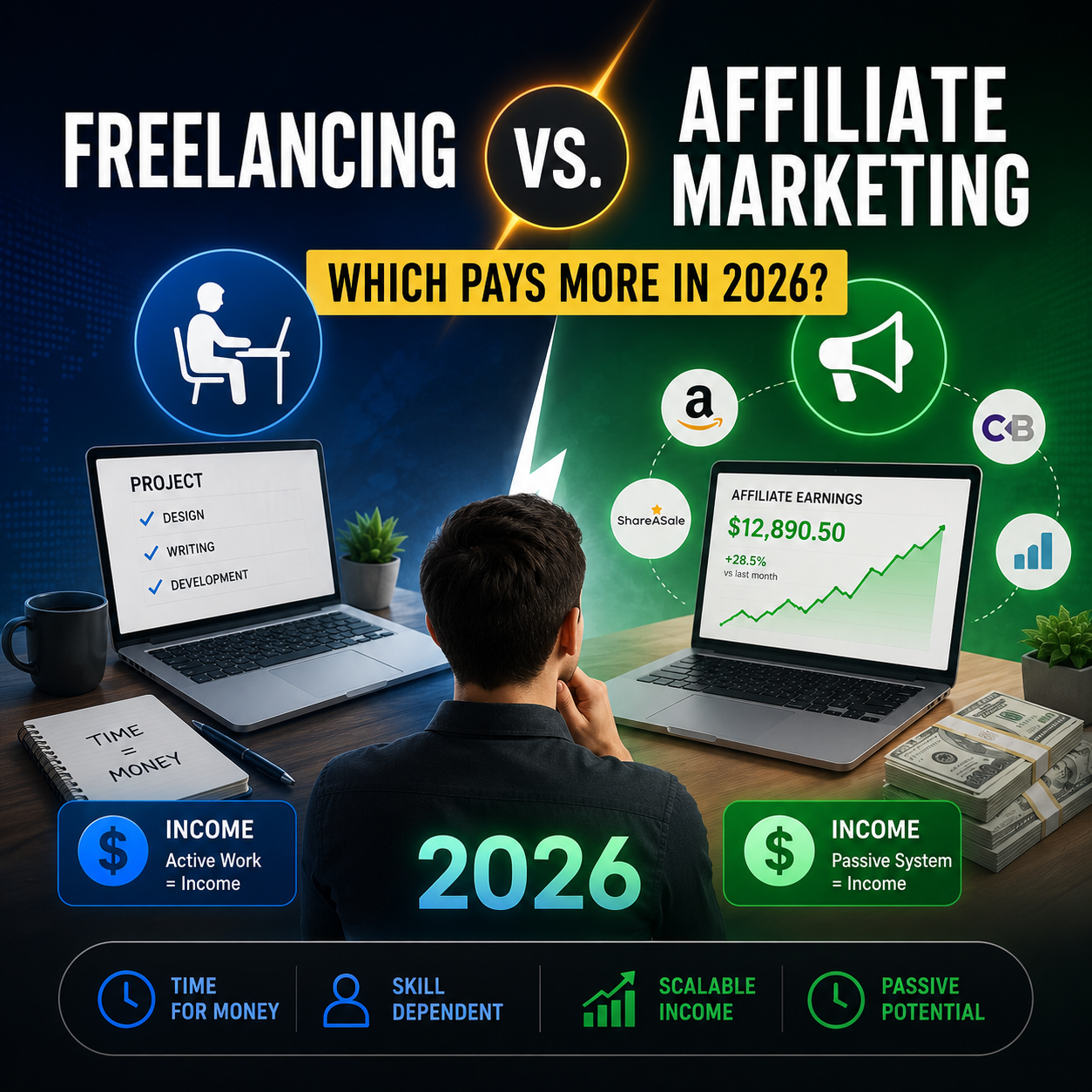
The Ultimate Global Guide to Building Income Online
The internet has created two of the most powerful wealth-building opportunities in modern history: freelancing and affiliate marketing.
Both models allow ordinary people to generate income online without needing a traditional office, expensive degrees, or large startup capital. Millions of people around the world are now using laptops, smartphones, AI tools, and digital platforms to create full-time income streams from anywhere.
But one major question keeps appearing across YouTube, Reddit, Facebook groups, and online communities:
Which pays more — freelancing or affiliate marketing?
The answer is not as simple as most people think.
Some freelancers earn six figures every year by selling high-value skills such as copywriting, programming, design, consulting, video editing, or AI automation services.
At the same time, some affiliate marketers generate passive income while sleeping by promoting software, financial services, digital products, or eCommerce brands.
One path offers faster cash flow.
The other offers scalability and long-term leverage.
One depends heavily on your time.
The other depends on systems, traffic, and marketing.
In this complete guide, we will break down:
- What freelancing really is
- What affiliate marketing actually looks like in 2026
- Which business model is easier for beginners
- Startup costs and risks
- Income potential
- Scalability
- Passive income opportunities
- AI automation impact
- Real-world case studies
- Which path fits different personality types
- How many successful entrepreneurs combine both models together
Whether you are a student, office worker, creator, trader, digital marketer, or someone trying to escape the 9-to-5 lifestyle, this guide will help you understand which path may generate more income for your future.
Chapter 1 — Understanding Freelancing
What Is Freelancing?
Freelancing is the process of offering your skills or services to clients independently rather than working as a full-time employee.
A freelancer is essentially a self-employed service provider.
Instead of receiving a fixed salary from one employer, freelancers work with multiple clients and get paid per project, per hour, or through monthly retainers.
Freelancing has exploded globally because businesses increasingly outsource work online.
Companies no longer need to hire full-time staff for every task.
Instead, they hire freelancers remotely.
This creates massive opportunities for skilled individuals worldwide.
Popular Freelancing Skills in 2026
Some of the most profitable freelancing categories include:
Writing and Copywriting
Businesses constantly need:
- Blog articles
- Email marketing
- Sales pages
- SEO content
- Product descriptions
- Social media captions
- Scripts for YouTube and TikTok
Good copywriters can charge from $50 to several thousand dollars per project.
Graphic Design
Designers create:
- Logos
- Branding kits
- Social media graphics
- Website UI/UX
- Ads
- Presentation decks
Visual branding has become critical for modern businesses.
Video Editing
The creator economy continues to grow rapidly.
YouTubers, influencers, businesses, and educators constantly hire editors for:
- Shorts
- Reels
- TikTok videos
- Podcasts
- Long-form content
- AI-generated videos
Web Development
Developers build:
- Websites
- SaaS platforms
- Landing pages
- Automation systems
- Apps
- eCommerce stores
This remains one of the highest-paying freelance industries.
AI Automation Services
AI has created entirely new freelance markets.
Businesses now hire specialists to:
- Automate workflows
- Build AI chatbots
- Integrate ChatGPT systems
- Create AI content pipelines
- Connect APIs
- Build no-code automations
This category is growing extremely fast.
How Freelancers Make Money
Freelancers usually monetize through:
Hourly Pricing
Clients pay per hour worked.
Example:
- $25/hour
- $50/hour
- $100/hour
Project-Based Pricing
Clients pay fixed fees.
Example:
- $500 website
- $1,000 video package
- $3,000 branding project
Retainers
Monthly recurring income.
Example:
- $2,000/month for social media management
- $5,000/month for marketing consulting
Retainers are extremely powerful because they create stable predictable income.
Advantages of Freelancing
Faster Income
Freelancing usually generates money faster than affiliate marketing.
Once you acquire a skill and land clients, cash flow can start almost immediately.
Low Startup Costs
Most freelancers only need:
- A laptop
- Internet connection
- Skills
- Portfolio
Startup costs are very low.
High Demand Worldwide
Businesses globally need digital services.
Freelancers can work remotely with international clients.
Flexible Lifestyle
Freelancers can:
- Work from home
- Travel
- Choose clients
- Set schedules
- Scale independently
Disadvantages of Freelancing
Income Depends on Time
Freelancers often trade time for money.
No work usually means no income.
Client Pressure
Difficult clients can create stress:
- Revisions
- Deadlines
- Negotiations
- Scope creep
- Late payments
Burnout Risk
Many freelancers become overworked because income is directly tied to productivity.
Scaling Challenges
Freelancing can become difficult to scale unless you:
- Build an agency
- Create systems
- Hire team members
- Productize services
Chapter 2 — Understanding Affiliate Marketing
What Is Affiliate Marketing?
Affiliate marketing is a business model where you earn commissions by promoting products or services from other companies.
When someone purchases through your referral link, you earn a commission.
Affiliate marketers do not need to:
- Create products
- Handle shipping
- Manage customer support
- Build inventory
They focus mainly on:
- Traffic
- Content
- Marketing
- Conversion systems
How Affiliate Marketing Works
The basic process looks like this:
Traffic → Content → Affiliate Link → Conversion → Commission
Example:
A creator publishes a YouTube video reviewing a trading platform.
Viewers click the affiliate link.
Some users register and deposit money.
The affiliate receives commissions.
Popular Affiliate Niches in 2026
Finance and Trading
One of the highest-paying industries.
Examples:
- Forex brokers
- Crypto exchanges
- Trading platforms
- Investment apps
- Copy trading
- Prop firms
This niche can generate recurring commissions.
Software and SaaS
Examples:
- AI tools
- Email marketing software
- Website builders
- CRM systems
- Automation platforms
Recurring SaaS commissions can become highly scalable.
Health and Fitness
Examples:
- Supplements
- Courses
- Fitness apps
- Wellness products
Technology
Examples:
- VPNs
- Hosting
- Laptops
- Gadgets
- AI tools
Education
Examples:
- Online courses
- Coaching
- Skill platforms
- Certifications
How Affiliate Marketers Generate Traffic
SEO Blogging
Writing articles that rank on Google.
Example:
- Product reviews
- Comparisons
- Tutorials
- Best tools lists
YouTube
One of the strongest traffic platforms globally.
Creators build audiences and monetize through affiliate links.
TikTok and Shorts
Short-form video has changed affiliate marketing completely.
Viral videos can generate huge traffic quickly.
Email Marketing
Affiliates build email lists and promote offers repeatedly.
Facebook Groups and Communities
Communities build trust and long-term monetization.
Advantages of Affiliate Marketing
Scalability
Affiliate marketing can scale massively.
A single piece of content may generate traffic for years.
Passive Income Potential
Unlike freelancing, affiliate systems can continue producing revenue without constant active work.
Unlimited Income Potential
There is theoretically no cap.
Traffic and conversions determine earnings.
No Product Creation
You sell other companies’ products.
Global Audience
The internet allows worldwide reach.
Disadvantages of Affiliate Marketing
Slow Start
Affiliate marketing often takes time before income appears.
SEO and audience building require patience.
Traffic Dependency
No traffic means no commissions.
Platform Risks
Algorithms change.
Google updates.
Social media accounts may lose reach.
Requires Marketing Skills
Affiliate marketing demands:
- Content creation
- Psychology
- Copywriting
- Funnels
- Analytics
Chapter 3 — Which Is Easier for Beginners?
Freelancing Is Usually Easier to Start
Freelancing generally provides faster beginner income.
Why?
Because clients already exist.
Businesses actively search for:
- Editors
- Designers
- Writers
- Developers
- Assistants
If you learn one monetizable skill, you can start pitching clients.
Affiliate Marketing Has a Longer Learning Curve
Affiliate marketing requires:
- Traffic generation
- Audience building
- Conversion optimization
- Content systems
- Patience
Many beginners quit before seeing results.
However, Affiliate Marketing Scales Better
Freelancing creates active income.
Affiliate marketing creates leveraged income.
That difference changes everything long term.
Chapter 4 — Startup Costs Comparison
Freelancing Startup Costs
Freelancing is extremely affordable.
Basic costs:
- Laptop
- Internet
- Portfolio website
- Learning resources
Possible startup range:
$0 to $500
Affiliate Marketing Startup Costs
Affiliate marketing can also start cheaply but scaling usually requires:
- Website hosting
- Domain
- Email software
- Content tools
- AI tools
- Ads (optional)
- SEO tools
Possible startup range:
$100 to $5,000+
Depending on strategy.
Chapter 5 — Income Potential Comparison
Freelancing Income Potential
Freelancers can make excellent money.
Examples:
Beginner
- $300 to $2,000/month
Intermediate
- $2,000 to $10,000/month
Advanced
- $10,000 to $50,000+/month
Top freelancers eventually build agencies.
Affiliate Marketing Income Potential
Affiliate income varies dramatically.
Beginner
- $0 to $500/month
Intermediate
- $1,000 to $10,000/month
Advanced
- $10,000 to $100,000+/month
Some top affiliates generate millions yearly.
Why Affiliate Marketing Can Outscale Freelancing
A freelancer may only work with a limited number of clients.
But an affiliate system can:
- Reach millions of people
- Generate traffic automatically
- Scale globally
- Produce recurring commissions
This leverage creates enormous upside.
Chapter 6 — Time Freedom Comparison
Freelancing = Active Income
Freelancers must continue working.
Even high-paid freelancers often remain deeply involved in daily operations.
Affiliate Marketing = Leveraged Systems
Affiliate systems can work continuously.
Old YouTube videos.
SEO articles.
Email funnels.
Communities.
These assets may continue generating income long after creation.
Chapter 7 — Stability and Risk
Freelancing Stability
Freelancing provides relatively stable cash flow once clients exist.
However:
- Clients may leave
- Income fluctuates
- Burnout happens
Affiliate Marketing Stability
Affiliate marketing is more volatile initially.
Traffic changes can affect earnings.
But once diversified, it becomes powerful.
Strong affiliates diversify across:
- SEO
- YouTube
- Communities
- Multiple offers
Chapter 8 — AI and the Future of Online Income
AI Is Changing Both Industries
Artificial intelligence is transforming freelancing and affiliate marketing rapidly.
AI Impact on Freelancing
AI can automate:
- Writing
- Editing
- Design
- Coding assistance
- Customer support
This creates both opportunities and competition.
Freelancers who use AI effectively become far more productive.
AI Impact on Affiliate Marketing
Affiliate marketers now use AI for:
- SEO research
- Content generation
- Video scripting
- Funnel writing
- Email campaigns
- Analytics
- Automation
AI massively increases scalability.
Chapter 9 — Personality Types and Best Fit
Best Personality for Freelancing
Freelancing fits people who:
- Enjoy direct client work
- Prefer predictable income
- Have strong technical skills
- Like structure
- Want faster monetization
Best Personality for Affiliate Marketing
Affiliate marketing fits people who:
- Enjoy content creation
- Think long term
- Understand psychology
- Like systems and automation
- Can tolerate delayed gratification
Chapter 10 — The Smartest Strategy: Combining Both
Why Many Entrepreneurs Use Both Models
The smartest online entrepreneurs often combine freelancing and affiliate marketing.
Example:
Step 1
Use freelancing to generate fast cash flow.
Step 2
Use profits to build affiliate systems.
Step 3
Create content assets.
Step 4
Scale traffic.
Step 5
Build recurring affiliate income.
This hybrid model is extremely powerful.
Chapter 11 — Realistic 12-Month Roadmap
Months 1–3
Focus:
- Learn one monetizable skill
- Build content habit
- Create social presence
- Study SEO and affiliate systems
Months 4–6
Focus:
- Get freelance clients
- Launch affiliate blog
- Publish content consistently
- Start YouTube Shorts
Months 7–9
Focus:
- Build email list
- Scale SEO traffic
- Improve conversion systems
- Automate workflows
Months 10–12
Focus:
- Build recurring income
- Launch community
- Expand internationally
- Diversify monetization
Chapter 12 — Common Mistakes Beginners Make
Freelancing Mistakes
- Underpricing
- No contracts
- Relying on one client
- Ignoring personal branding
- No systems
Affiliate Marketing Mistakes
- Chasing shortcuts
- Spamming links
- No audience trust
- Quitting too early
- Ignoring SEO
Chapter 13 — Best Platforms for Freelancers
Popular Freelance Platforms
Upwork
Large global marketplace.
Fiverr
Strong for beginners.
Contra
Modern creator-focused platform.
Excellent for high-ticket clients.
X (Twitter)
Many freelancers now acquire clients organically.
Chapter 14 — Best Platforms for Affiliate Marketers
SEO Platforms
- WordPress
- Medium
- Ghost
Video Platforms
- YouTube
- TikTok
- Instagram Reels
Community Platforms
- Discord
- Telegram
- Facebook Groups
Chapter 15 — Which Pays More in the Long Run?
Short-Term Winner: Freelancing
Freelancing generally wins early.
It is easier to generate initial income.
Long-Term Winner: Affiliate Marketing
Affiliate marketing often wins long term because:
- It scales better
- It creates leverage
- It can generate passive income
- It allows global reach
- Systems compound over time
Final Verdict
Freelancing and affiliate marketing are both legitimate paths to building online income.
Neither is perfect.
Neither is guaranteed.
But both can become life-changing when executed properly.
If you need faster cash flow, freelancing may be the better starting point.
If you want scalable systems and long-term leveraged income, affiliate marketing offers enormous upside.
The most successful digital entrepreneurs in 2026 are often combining both.
They:
- Use freelancing to create capital
- Build audiences through content
- Scale affiliate systems
- Automate operations with AI
- Create digital ecosystems instead of single income streams
The internet economy rewards people who build assets.
Skills are assets.
Content is an asset.
Communities are assets.
Traffic is an asset.
Trust is an asset.
Whether you choose freelancing, affiliate marketing, or both, your long-term success will depend on consistency, learning, adaptation, and execution.
The opportunity is massive.
The tools are more accessible than ever.
And for people willing to build patiently, the digital economy of 2026 may become one of the greatest opportunities in modern history.
Frequently Asked Questions
Can beginners start affiliate marketing without money?
Yes, many people start using free traffic platforms such as TikTok, YouTube Shorts, Facebook Groups, and SEO blogging.
However, success still requires time, learning, and consistency.
Is freelancing safer than affiliate marketing?
Generally yes in the short term because client work creates more predictable cash flow.
Can affiliate marketing become passive income?
Yes.
Strong systems, SEO articles, YouTube videos, and email funnels can generate long-term recurring revenue.
Which business model grows faster?
Freelancing usually grows income faster initially.
Affiliate marketing scales faster long term.
Can AI replace freelancers?
AI will replace some low-level tasks.
However, freelancers who learn AI tools will likely become far more competitive.
Can I do both freelancing and affiliate marketing together?
Absolutely.
This is one of the strongest online business combinations today.
Recommended Platforms for Affiliate Marketers in 2026
For readers interested in exploring affiliate marketing opportunities in finance and trading, several global platforms offer competitive programs for creators, marketers, bloggers, and community builders.
Some of the most popular options include:
- Binance Affiliate Programhttps://www.binance.com/vi/register?ref=CKYCVX0B — One of the world’s largest crypto ecosystems with multiple monetization opportunities.
- Bybit Affiliate Programhttps://partner.bybit.com/b/24095 — Popular among crypto traders and content creators focused on derivatives and copy trading.
- BingX Affiliate Programhttps://bingx.com/invite/HJXF4K — Known for social trading and beginner-friendly crypto features.
- Exness Affiliate Programhttps://one.exnesstrack.org/a/kfmuhfhs0m — A well-known forex broker with global reach and long-term IB opportunities.
- XM Affiliate Programhttps://affs.click/YtywY — Offers various partnership models for forex affiliates and educators.
- Vantage Affiliate Programhttps://vigco.co/3uayqy — Increasingly popular among traders looking for copy trading and multi-asset platforms.
The best affiliate program depends on your audience, traffic source, content strategy, and niche focus.
Many successful affiliate marketers combine:
- SEO blogging
- YouTube content
- Community building
- Email marketing
- Educational tutorials
To create long-term recurring income streams.
Conclusion
The debate between freelancing and affiliate marketing is not really about choosing one forever.
It is about understanding:
- Your current situation
- Your strengths
- Your goals
- Your time horizon
- Your risk tolerance
Freelancing may help you survive.
Affiliate marketing may help you scale.
Combined together, they can become an incredibly powerful digital business ecosystem.
The future belongs to creators, marketers, builders, and system thinkers.
And the people who start today may have an enormous advantage over those who wait.
