


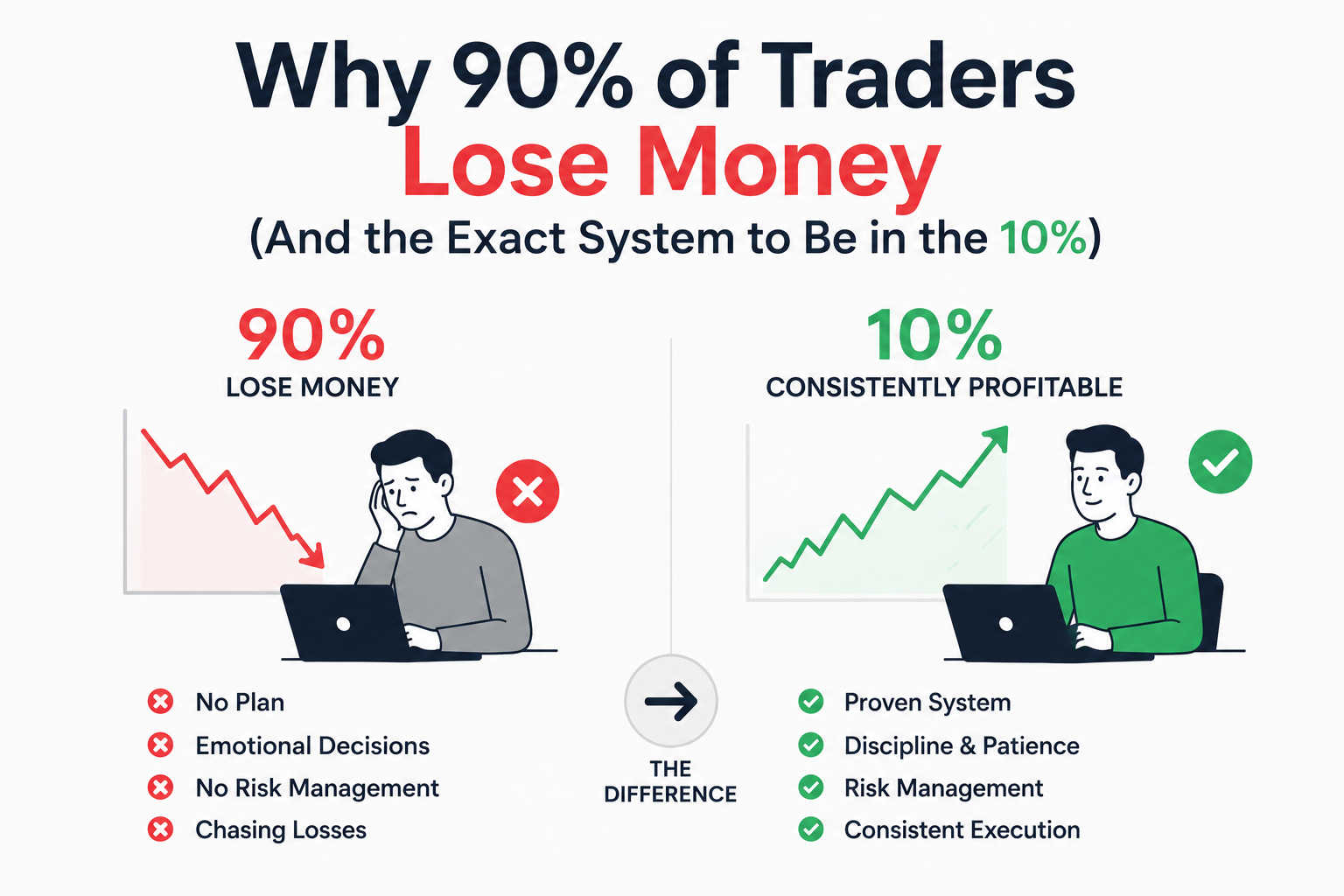
I was in the 90% before I was in the 10%.
Not metaphorically. Literally. I blew my first account in six weeks. Lost $340 trying to day-trade EUR/USD without a strategy, without a stop loss, and without any understanding of why the market was doing what it was doing. I traded on gut feel, YouTube tips, and the misguided belief that watching charts long enough would somehow reveal a pattern only I could see.
It did not.
The 90% failure rate in trading is not a myth or an exaggeration. Financial regulators in Europe require CFD brokers to publish the percentage of retail clients who lose money. On most major regulated brokers, the number sits between 70% and 82%. For unregulated brokers, the number is almost certainly higher. The full picture, including traders who quit before losing everything, likely puts the real failure rate closer to 90-95%.
The question that actually matters is not why 90% lose. It is what the 10% do differently — specifically, concretely, and in a way you can replicate starting this week.
I have been in the 10% for 18 months now. Not because I am smarter. Not because I have some secret signal or insider knowledge. Because I made specific changes to specific behaviors after specific failures. Every one of those changes is documented in this article.
The 90% vs. The 10%: A Direct Comparison
Before we go into the reasons traders fail, let me show you the complete picture. The 10% are not better at predicting markets. They are better at everything that happens before and after the trade.
| Area | 90% (Losing Traders) | 10% (Profitable Traders) |
| Motivation | “Get rich quick” — trading as lottery | Building a skill and a systematic edge |
| Risk per trade | Whatever feels right — often 10-30% | Fixed 1–2% of account per trade |
| After a losing trade | Double position to recover losses | Accept the loss, analyze, move forward |
| Strategy | Switches strategies after 3 losing trades | Tests one strategy for 6+ months minimum |
| Trading journal | Never uses one | Logs every trade, reviews weekly |
| Leverage used | Maximum available — “more leverage = more profit” | Conservative 1:10–1:30, scales gradually |
| Stop loss | Often skipped — “it will recover” | Always set before entering the trade |
| Broker choice | Random — based on ads or bonus offers | Verified regulation, tested withdrawals |
| Emotions during trading | Fear and greed drive every decision | Pre-defined rules execute automatically |
| When market goes against them | Holds and hopes — “it will turn around” | Cuts loss at stop, preserves capital |
Notice what is not on that list: intelligence, luck, secret indicators, or expensive courses. The difference is entirely behavioral. That is the most important and most uncomfortable truth in trading: the market does not care how smart you are. It only responds to what you do.
The 7 Real Reasons 90% of Traders Lose
These are not theories. They are the exact seven mistakes I made, have seen others make, and have studied in the trading psychology literature. Each one has a specific fix.
REASON #1
🎰 They Treat Trading Like Gambling, Not a Business
Stat: Traders who treat markets like a casino blow their first account in an average of 6-8 weeks.
The single most destructive mindset in trading is the belief that the market owes you money. That if you watch it long enough, try hard enough, or make bold enough trades, the money will eventually come.
Trading does not work like that. Trading is a business. It has startup costs (your learning curve and early losses), operating expenses (spreads, commissions), inventory management (your capital), and a product (your strategy and execution). Businesses that operate without a plan, track their numbers, or manage their costs do not survive. Neither do traders who operate the same way.
Every professional trader I know thinks in terms of edge, expectancy, and risk-adjusted returns. Not in terms of “how much can I make today.”
The 90% ask: “How much can I make?” The 10% ask: “What is my statistical edge over a large sample of trades?”
📌 Truth: If you do not know your win rate, average win, average loss, and risk-reward ratio from at least 50 trades, you do not know whether your strategy actually works. You are guessing.
✅ The Fix: Calculate your expectancy: (Win Rate × Average Win) — (Loss Rate × Average Loss). If the number is positive, your strategy has edge. If it is negative or zero, you need a new strategy or better execution before risking real money.
REASON #2
💸 They Have No Risk Management Whatsoever
Stat: Studies show the majority of retail traders never use stop losses consistently. This single fact explains most account blow-ups.
I have spoken to hundreds of traders in our community. The pattern among those who have blown accounts is almost always the same: one trade, no stop loss, market moved against them, they held hoping it would recover, it did not.
One bad trade without a stop loss can wipe out months of profitable trading. Not because the trader was stupid. Because they skipped the single most important rule in all of trading.
Risk management is not one skill among many. It is the prerequisite skill that makes all other skills worth having. A brilliant strategy with poor risk management will eventually blow up. A mediocre strategy with excellent risk management can survive long enough to be refined into something profitable.
The math of ruin: if you lose 50% of your account, you need to make 100% just to break even. Lose 75% and you need 300%. The deeper the hole, the steeper the climb back out.
📌 Truth: A 10% risk per trade with a 60% win rate will eventually blow your account. It is mathematically certain. The probability of several consecutive losses at 10% risk creates a mathematically inevitable account wipeout given enough time.
✅ The Fix: Risk exactly 1-2% of your account per trade. Never more. Write it on paper and tape it next to your screen. This single rule, applied consistently, is what separates survivors from statistics.
REASON #3
😤 Emotions Make Every Trading Decision
Stat: Fear and greed account for an estimated 80% of retail trader losses according to behavioral finance research.
Fear makes you close profitable trades too early. Greed makes you hold losing trades too long. Revenge makes you trade larger after a loss to “get it back.” Overconfidence makes you trade more after a winning streak.
Every one of these emotional responses is rational from a psychological perspective and catastrophic from a trading perspective. Your brain was not designed for trading. It was designed for survival. In survival situations, cutting losses quickly and holding onto gains is optimal. In trading, your brain’s survival instincts produce exactly the wrong behavior at every decision point.
I lost $340 in my first account because I was emotional. I held a losing GBP/USD trade for three days because closing it felt like admitting defeat. The market did not care about my feelings. It kept moving against me until the position was unrecoverable.
The solution to emotional trading is not “feeling less.” It is removing decisions from the emotional moment entirely. This is exactly why I transitioned to systematic trading — using bots and copy trading as the backbone of my strategy, as documented in I Let a Bot Trade My $1,000 Account for 90 Days.
📌 Truth: Your most expensive trades will always be the ones where you felt the most certain. Certainty in trading is a warning sign, not a green light.
✅ The Fix: Write your trading plan before the market opens. Enter only the setups that match your pre-written criteria. If a trade does not appear on your planned setup list, do not take it. Plan the trade. Trade the plan.
REASON #4
⚡ They Over-Leverage and Over-Trade
Stat: The average losing retail trader uses 5-10x more leverage than the average profitable trader, according to broker data analysis.
Leverage is the most seductive feature in retail trading. The ability to control a $100,000 position with $1,000 sounds like an opportunity. In reality, it is a margin for error of exactly one percent. A 1% adverse move eliminates your entire position.
New traders see leverage as a way to make more money. Experienced traders see it as a risk amplifier that demands proportionally more skill to survive. The same 10% account drawdown on 1:10 leverage feels uncomfortable. On 1:100 leverage, it requires the market to move only 1% against you.
Over-trading is leverage’s equally destructive partner. More trades do not mean more profit. More trades mean more spread costs, more emotional decisions, more opportunities for error, and more exposure to random market noise. Professional traders typically make 5-20 high-quality trades per week. Amateur traders make 50-200 low-quality trades per week.
This is one of the concrete advantages of bot trading: the bot only takes setups that meet its programmed criteria. It does not trade out of boredom. It does not trade to “keep busy.” If no valid setup appears, it does nothing. That discipline is harder for humans to replicate emotionally than any technical skill.
📌 Truth: Most retail traders’ accounts are destroyed not by market conditions, but by leverage combined with a string of emotional trades that none of their planning anticipated.
✅ The Fix: Start at 1:10 leverage maximum. Treat every 1% of account risk as if it could be your last dollar. Over-trading fix: limit yourself to maximum 3 open trades simultaneously. Quality over quantity.
REASON #5
🎲 They Chase Win Rate Instead of Expectancy
Stat: A trader with a 40% win rate can be more profitable than one with 80% — if their reward-to-risk ratio is right.
Most losing traders obsess over one number: win rate. They want to be right more than they want to make money. These are not the same thing.
Here is the math that changes everything:
| Win Rate | Risk:Reward | 100 Trades | Net Result | Verdict |
| 40% | 1:1 | 40W / 60L | -20 units | ❌ Losing — most casual traders |
| 50% | 1:1 | 50W / 50L | Break even | 😐 After spread/fees, actually losing |
| 40% | 1:2 | 40W / 60L | +20 units | ✅ Profitable with only 40% win rate! |
| 50% | 1:2 | 50W / 50L | +50 units | ✅ Strongly profitable |
| 33% | 1:3 | 33W / 67L | +32 units | ✅ Profitable — only right 1 in 3 times! |
Read that table slowly. A trader who wins 40% of the time but targets 2:1 reward-to-risk is profitable. A trader who wins 50% of the time at 1:1 reward-to-risk is not — because spreads and commissions make 50% a losing proposition in practice.
Most traders in the 90% have reward-to-risk ratios below 1:1 because fear makes them close winners too early and hope makes them hold losers too long. The result is small wins and large losses — the exact opposite of what creates sustainable trading profit.
📌 Truth: Having a 70% win rate sounds impressive until you realize the average win is $50 and the average loss is $300. That is a losing strategy regardless of how often you are right.
✅ The Fix: Define your minimum reward-to-risk ratio before entering any trade. My rule: minimum 1:2. I risk $100 only if the target is at least $200. This one rule transformed my trading profitability more than any technical strategy change.
REASON #6
🎭 They Copy Gurus and Follow Random Signals
Stat: An estimated 95% of paid trading signals and courses produce no long-term positive results for buyers.
The trading education industry is largely built on a cruel irony. The people who most effectively profit from retail traders are not other traders. They are the sellers of courses, signals, and strategies to retail traders.
Think about the incentive structure. If a trader had a consistently profitable strategy that generated 20% returns per month, why would they sell access to that strategy for $99? The answer is they would not. The profitable traders keep their edge. The ones selling courses have typically found their edge in selling courses.
I am not saying all trading education is fraudulent. Some is genuinely valuable. But the signal-follower who blindly copies trades without understanding the underlying logic is in a fundamentally weak position: they cannot adapt when conditions change, they cannot manage their emotions when the signal is underwater, and they have no ability to evaluate whether the signal source is actually profitable or simply lucky.
Copy trading is different from signal following, and the distinction matters. Legitimate copy trading on platforms like Exness Social Trading shows you verified, audited trading histories going back months or years. You are not following a claim. You are following a verified track record. Read our full guide: Copy Trading for Beginners.
📌 Truth: Anyone selling a signal service with guaranteed returns is either lying about the guarantees or lying about the returns. Markets offer no guarantees. Real profitable traders never make that claim.
✅ The Fix: Before following any signal or copying any trader, demand a verified track record of at least 6 months. Not a screenshot. Not a back-test. A live, audited performance history on a regulated platform.
REASON #7
🏛️ They Use Unreliable Brokers
Stat: Poor broker infrastructure silently destroys profitable strategies through wide spreads, slow execution, and withdrawal problems.
This is the most underestimated reason traders fail, and the one I talk about most because I experienced it firsthand.
My second trading account was with a broker I found through a flashy ad offering a $50 deposit bonus. The spreads on EUR/USD averaged 2.8 pips. The execution had consistent slippage. When I requested a withdrawal, the process took 19 business days and required three rounds of re-submitting the same documents.
A broker with 2.8-pip spreads on EUR/USD costs you approximately $28 per standard lot traded. A Raw ECN account with 0.0-0.2 pip spreads costs approximately $3-5 per lot. On a bot running 200 trades per month, that spread difference alone is the difference between a profitable system and a losing one. The strategy is identical. The broker infrastructure determines the outcome.
After testing six brokers, I settled on Exness as my primary broker (referral code: kfmuhfhs0m) and Vantage as my second (partner code: ayQVh5rp). Both have Tier-1 regulation, near-zero raw spreads, instant withdrawals, and platforms that support automated trading. See the full broker comparison in How to Choose a Forex Broker: 9 Must-Check Things.
📌 Truth: A profitable strategy on a bad broker can become a losing strategy. Spreads, execution speed, and slippage are silent performance killers that most traders never measure.
✅ The Fix: Test every broker with a small deposit before committing significant capital. Measure: spread on EUR/USD during London session (target: under 0.5 pips on raw accounts), execution time (target: under 100ms), and withdrawal speed (target: same day or next day).
How to Be the 10%: The Complete System
Now for the actionable part. Here is the exact system I use — and that I have shared with traders in our community who have moved from consistently losing to consistently profitable.
SOLUTION #1
📋 Trade With a Written Plan, Not Gut Feel
Before the market opens each day, write your trading plan. This is not optional for 10% traders. It is the foundation of everything.
Your daily trading plan must answer:
What pairs am I trading today? (maximum 3)
What setup am I looking for? (specific entry criteria in writing)
What is my maximum daily loss? (if I hit this number, I stop trading for the day)
What is my target for today? (realistic, not aspirational)
What market conditions would invalidate my setups? (news events, unusual volatility)
If a trade does not appear on this written plan, it does not happen. This rule eliminates impulsive trades — the single largest source of losses for most retail traders.
SOLUTION #2
🛡️ Build the Risk Management Habit That Cannot Break
Risk management is not a strategy. It is a habit. And like all habits, it is most powerful when it is automatic.
The 1-2% rule, mechanically applied:
Step 1: Account size = $1,000. Maximum risk per trade = $10-$20.
Step 2: Identify your stop loss level based on chart structure (not an arbitrary number).
Step 3: Calculate: (Risk amount ÷ stop loss in pips) = position size. Use a free position size calculator.
Step 4: If the position size feels too small, that is the risk management working correctly. Never override it.
Step 5: Set the stop loss in the platform before you enter. Not mentally. Actually in the platform.
For traders who want to automate this process entirely, bot trading removes the position sizing calculation from your hands. The bot calculates and executes the correct position size for every trade based on current account balance. This is one of the core advantages I describe in Trading Bots Explained.
SOLUTION #3
🤖 Use Automation to Remove Emotion From the Equation
The cleanest solution to emotional trading is removing the human decision-maker from the moment of execution. This is what bots and copy trading accomplish.
I currently allocate my capital across three approaches: a forex bot running 24/5 on MT5, copy trading following two verified traders, and a small allocation for manual trades on high-conviction setups only.
The bot has executed over 600 trades. I have overridden exactly zero of them. Not because I am disciplined beyond human capacity. Because I set the rules when I was rational and clear-headed, and the bot enforces them during the volatile moments when I would have deviated. See the full results: I Let a Bot Trade My $1,000 Account for 90 Days.
For those not ready for bot trading, copy trading is the bridge. You remove the trade execution decision from yourself entirely by following a verified professional. Open a free account with Exness (code: kfmuhfhs0m) and navigate to their Social Trading section to browse verified trader profiles.
SOLUTION #4
📓 Keep a Trading Journal and Actually Use It
The gap between losing traders and profitable traders is largely a gap in self-knowledge. Profitable traders know their patterns — their strengths, their tendencies, their emotional triggers. Losing traders do not, because they do not track anything.
A trading journal does not need to be complicated. For each trade, record:
Date, pair, direction (long/short), entry price, stop loss, take profit
Reason for entering (what setup triggered this trade?)
Outcome (profit/loss in pips and dollars)
Emotional state when entering (calm, anxious, overconfident, FOMO)
What I would do differently
Every Sunday, review the week. Look for patterns: Are you losing more on news days? Do you over-trade on Mondays? Are your biggest losses all revenge trades after an initial loss? The journal turns your trading history into a learning system.
I use Claude AI to analyze my journal entries: I paste my week’s trades and ask it to identify bias patterns. The AI catches things I miss because I am too close to the data. See our full AI tools guide: Best Free AI Tools for Traders.
SOLUTION #5
⏳ Develop the Patience That 90% Do Not Have
Patience in trading manifests in three distinct ways, each one a competitive advantage against the 90%:
Patience to wait for the right setup. The 10% skip 80% of potential trades because those trades do not meet their criteria. The 90% take every trade that looks vaguely similar to what they want. Quality setups are rare. Patience captures them. Impatience dilutes them.
Patience to hold through temporary drawdowns. Every strategy, including the profitable ones, will go through losing periods. The 90% interpret a losing week as evidence their strategy is broken. The 10% interpret it as normal statistical variance and hold course. The ones who stay patient capture the recovery. The ones who quit do not.
Patience to let results compound over time. The 90% want $1,000/week in month one. The 10% accept $50/week in month one because they understand that $50 compounding at 10% monthly becomes $3,200/month in 18 months. The math rewards patience. The market punishes urgency.
This compounding patience is the exact mindset I document in From $0 to $5K/Month: My 6-Month MMO Journey. The traders who succeed are never the ones who rushed. They are always the ones who built.
The 10% Framework: Your Complete Checklist
Use this table as a weekly self-assessment. For every row where you tick the left column, you have identified an area to improve. For every row where you tick the right column, you are operating like the 10%.
| Framework Element | What the 90% Do | What the 10% Do Instead |
| Capital Allocation | All in on one strategy, one account | Split: 40% bots, 30% copy, 20% manual, 10% reserve |
| Risk Management | “I will stop when it hurts too much” | Fixed 1–2% max per trade, written rule, never broken |
| Strategy Testing | Live money immediately with YouTube strategy | Demo account for 60 trades min before going live |
| Losing Periods | Panic, change strategy, over-trade to recover | Accept as normal, analyze data, hold course |
| Automation | Manual trading 24/5 driven by emotion | Bot + copy trading handle non-peak hours |
| Broker Selection | First result on Google, attractive bonus | Tier-1 regulated, tested withdrawal, raw spreads |
| Trading Journal | No journal — “I remember my trades” | Every trade logged, reviewed weekly with AI analysis |
| Time Horizon | “I want $1,000/week in month one” | Year 1 = learning, Year 2+ = scaling profitably |
Honest assessment: when I first ran through this checklist 18 months ago, I was in the left column for 9 out of 10 rows. Today I am in the right column for all ten. That shift did not happen overnight. It happened through deliberate, consistent changes to specific behaviors over 12 months.
Your Practical Starting Point: This Week
Everything in this article is actionable immediately. Here is where to start:
Today: Download a free spreadsheet and create your trading journal template. Log every trade from this moment forward.
This week: Write your trading rules. What is your risk per trade? What setups qualify? What conditions exclude you from trading? Write it all down.
This week: Open a free account on Exness (code: kfmuhfhs0m). Use the demo account for 30 days minimum before going live. Browse their copy trading section and identify two traders you would consider following.
Next week: Read our guide on How to Set Up a Forex Trading Bot in Under 30 Minutes and consider whether automated trading fits your situation.
Month 2–3: Review your journal data. Calculate your actual win rate, average win, average loss, and expectancy. If the expectancy is negative, adjust before risking more capital. If it is positive, scale carefully.
Month 6+: With 6 months of verified data, you will know with mathematical certainty whether your strategy has edge. Most traders never get to this point because they quit during the difficult early months. You will not, because you now understand that difficulty is normal.
Frequently Asked Questions
Is it really true that 90% of traders lose?
Roughly, yes. European regulations require CFD brokers to disclose the percentage of retail clients who lose money. Across major regulated brokers, this consistently sits between 70-82%. Unregulated brokers likely have higher loss rates. When you include traders who quit before formal data capture, the 90% figure is a reasonable estimate.
How long does it take to become consistently profitable?
Honest answer: 12-24 months of focused learning, journaling, and disciplined application of risk management. Traders who expect to be consistently profitable within three months are almost always disappointed. Traders who accept a 12-month learning curve and measure progress in incremental improvements tend to get there.
Can I skip the learning curve with copy trading or bots?
Yes and no. Copy trading and bot trading can generate income while you learn, which is exactly how I structured my journey in How I Built a $3,000/Month Passive Income System. But you still need to understand risk management, trader selection, and platform fundamentals. Automation reduces emotional mistakes — it does not eliminate the need for judgment.
What is the single most important thing I can do right now?
Apply the 1-2% risk rule to every single trade you make from this moment forward. Before any strategy, before any broker choice, before any other change — this one rule is the single most impactful improvement available to any trader who is not already doing it. Your account will survive to fight another day.
Related Articles From MMOIncome
The tools and strategies that help traders move from the 90% to the 10%:
Start with automation: Copy Trading for Beginners: Complete 2026 Guide
Bot trading evidence: I Let a Bot Trade My $1,000 Account for 90 Days
Bot vs manual: Manual vs. Bot Trading: Real Numbers After 6 Months
Bot setup guide: How to Set Up a Forex Bot in Under 30 Minutes
Broker selection: How to Choose a Forex Broker: 9 Must-Check Things
Full income system: How I Built a $3,000/Month Passive Income System
Real journey: From $0 to $5K/Month: My 6-Month MMO Journey
Join the MMOIncome Community
Connect with other traders who are building their way into the 10%. Real results, real accountability, real community:
📘 Facebook Fanpage: facebook.com/mmoincomes
👥 Facebook Group: Join MMOIncome Community — Share your trading journal, get strategy feedback, and find accountability partners.
🎬 YouTube: youtube.com/@mmoincome — Live trading sessions, psychology breakdowns, and weekly market analysis.
The Choice Is Yours
The 90% figure is not fate. It is not a fixed law of trading. It is a description of what happens when traders enter the market without the behaviors, mindset, and systems that the 10% use consistently.
You now know exactly what those behaviors are. You know the seven specific reasons traders fail. You know the five concrete solutions. You have the comparison framework, the risk management math, and the practical starting point.
The only question left is whether you will actually change your behavior — or continue doing what the 90% do.
Start your foundation today: Open Exness Account — referral code: kfmuhfhs0m. Demo account first. Strict 1-2% risk rule from day one. Journal every trade. Review every week.
Add a second broker when ready: Vantage — partner code: ayQVh5rp. Diversify across brokers the same way you diversify across strategies.
The 10% is not a talent pool. It is a behavior pool. And behavior is always a choice.
Risk Warning: Forex trading and CFD trading involve substantial risk of loss. The majority of retail investor accounts lose money when trading CFDs. The 90% failure statistic referenced in this article is derived from published broker disclosure data and academic research — individual results vary significantly. Past performance is not indicative of future results. Never invest more than you can afford to lose. This content is for educational purposes only and does not constitute financial advice.
© 2026 MMOIncome.com — Smart Money. Smart Systems. Real Income.
